
Interview with Carolyn Philstrom, Hospice Chaplain, Spinal Muscular Atrophy Mom, Rare Disease and Newborn Genomic Sequencing Advocate
“There are so many health disparities and inequities, even just within Minnesota but dramatically so globally. Our story was the best case scenario. We still to this day see cases where insurers refuse to cover gene therapies, and families have to fight and kids get delayed treatment, which means a loss of motor neurons, which means children might be in wheelchairs for the rest of their lives. It makes me really angry, and I try to use that anger as fuel to advocate for others”
– Reverend Carolyn Philstrom
The Best Case Scenario: A Science and Healthcare Success Story
Carolyn Philstrom had a more eventful entrance into motherhood than most parents. Shortly after birth, her son Edan was one of the first babies to be diagnosed with Spinal Muscular Atrophy (SMA) through Minnesota’s newborn disease screening panel. He was also one of the first patients to receive Zolgensma, a gene therapy that has entirely staved off the disease’s typical devastating effects.
SMA is a genetic condition that causes muscles to weaken over time due to the loss of spinal cord nerve cells, also known as motor neurons. The disease is caused by defects in the Survival Motor Neuron 1 (SMN1) gene. Symptoms from the disease typically begin to manifest in early childhood, and SMA is the leading genetic cause of death in infants and toddlers; however, this has changed in countries where treatment is available. Once muscles weaken sufficiently, patients need supportive devices and wheelchairs to move, with some children never walking.
SMA is one of the most common rare diseases, affecting approximately 10,000 to 25,000 Americans. Between 1 in 6,000 to 1 in 11,000 babies are born with SMA. Patients inherit the mutation from both parents, as it follows an autosomal recessive pattern. If both parents carry the gene, babies have a 25% chance of inheriting the disease. While people of all races can get SMA, it is about twice as common in White and Asian people as it is for Black and Hispanic people; about 1 in 50 White people might carry the gene mutation.
Before receiving her son’s screening result, Carolyn had never heard of SMA.
“I was not familiar with SMA at all. The closest disease to SMA I had heard of was ALS (Amyotrophic Lateral Sclerosis). Oftentimes, SMA is described as ALS but in children, which is just so, so terribly sad,” she recounts.
In January 2018, only Minnesota, Missouri, and Utah included SMA as part of their statewide newborn screening panel. Today, it is included on the Secretary of the Department of Health and Human Services (HHS)-managed list of disorders in the Recommended Uniform Screening Panel for state universal newborn screening, and all fifty states screen newborns for it. The diseases on the list are chosen because there is a benefit to screening and / or there are effective treatments. The newborn screening test for SMA can correctly identify 95% of SMA cases.
“When Edan was five days old, we got a phone call from our doctor telling us that he was diagnosed with a disease on the newborn screening. He warned us that we needed to be looking out and prepared to take him to the emergency room to make sure that he was breathing okay. Here we were brand new parents getting this phone call that was just terribly stressful,” Carolyn recalls.
“He was born on a Monday, we got the call on Saturday, and the rest of Saturday and Sunday were the longest days of my life. We did not get connected to the pediatric neurologist until early the next week, which looking back I’m like, wow, that was actually great healthcare compared to what a lot of my friends are still dealing with around the world. But it was two really horrible long days at the time.”
Carolyn and her family were connected with a pediatric neurologist a twenty-minute drive away in the Twin Cities metro of Minnesota. Their clinical team advised them about treatment options, which at the time was primarily Biogen’s drug Spinraza. Spinraza is an injection that requires re-administration every four months indefinitely (after a series of initial loading doses) and was approved by the FDA in 2016. The drug induces the SMN2 gene to produce more functional SMN protein, compensating for the faulty SMN1 gene in patients. The treatment is invasive as it must be injected directly into the spinal fluid so it can reach motor neurons, but it significantly lowered the risk of death or permanent ventilation while improving motor milestones in treated infants in its Phase 3 ENDEAR study.
“Spinraza is a very effective drug if it’s administered early enough, so at first were like okay this is a great option, if he has to get these injections every four months for the whole rest of his life that will be okay. We were very concerned about the price, though, since they were $125,000 per injection,” Carolyn explains.
As a newborn Edan received initial treatment with Spinraza. Then Carolyn heard from the pediatric neurologist that a colleague in Madison, Wisconsin worked at a clinical trial site for a new gene therapy for SMA and the manufacturer Novartis was willing to give Edan their therapy Zolgensma for free through an early access program, as it was still being evaluated by the FDA at the time.
Zolgensma is an adeno-associated virus vector-based gene therapy for children younger than 2 years old with SMA, administered through a one-time IV infusion. Because Zolgensma cannot reverse any motor neuron damage that has already been caused by SMA, it is not considered a cure. However, early treatment with the therapy stops the progression of the disease. If the therapy is administered before patients experience motor neuron damage, it never occurs.
“We were like wow, this is a one time thing, and the clinical trial results look really good. It would give him a corrected copy of the original gene, so we decided to switch him to the gene therapy. So on his three month birthday, Edan received the gene therapy Zolgensma in Madison, Wisconsin on a day I’ll never forget,” Carolyn shares. “He was like the pioneer kid, born just at the right time. He was born in October 2018, Zolgensma was approved in May 2019, but he was able to get it in January.”
Healthcare in the Star of the North State
Even before becoming an SMA mom, Carolyn had spent a lot of her career thinking about biomedical ethics and spirituality in healthcare. A Minnesota native, Carolyn attended seminary to become a Lutheran pastor in Chicago. There she met her now husband, who is a fellow Lutheran pastor. After a pastoral stint in North Dakota, the couple settled in Minneapolis (population: 429,000), Minnesota (population: 5.8M).
“I love people, I love the pastoral care side of things, and so I really wanted to go into healthcare chaplaincy so that I could do the pastoral care side of things full time,” Carolyn recounts.
She completed a residency at the University of Minnesota Medical Center in Minneapolis, a large research hospital. In the hospital she worked in a range of units, from orthopedic to behavioral health. Now she is a hospice chaplain, focused on providing the emotional and spiritual support for patients of all religious backgrounds and their families as they transition through end-of-life care.
Minnesota is considered to have strong healthcare, even being ranked as the state with the best healthcare by some metrics. Minnesota is also the northernmost state in the continental US. Notably, the state has a high proportion of Lutherans partially due to the large population of residents with Scandinavian and German ancestors; 15% of adults in the Minneapolis-St. Paul metro area identify as Lutheran.
Famed Minnesotans include musician Bob Dylan, writer F. Scott Fitzgerald, and actress Judy Garland. The iconic Mall of America in Bloomington, Minnesota contains 520 stores, a 7-acre theme park, and its own zip code.
Although he was initially from Missouri, another honorary Minnesotan is Dr. Robert Guthrie. A University of Minnesota Medical School graduate, Dr. Guthrie developed the technology that allows for newborn disease screening by collecting a few drops of blood from a baby’s heel in the late 1950s. Dr. Guthrie’s niece had phenylketonuria (PKU) and his son also had developmental disabilities, motivating his research.
While routine newborn screening began in Massachusetts in 1963, Minnesota quickly followed by starting its program in 1964 when many states began testing babies for PKU, a genetic disorder that can be well-managed if caught early. Dr. Guthrie’s tool continues to allow for widespread, low-cost newborn disease screening that allows for meaningful early interventions.
Becoming Advocates: The Cost of a Near-Cure
While the Philstroms received Zolgensma for free, once the drug achieved FDA approval, it became the most expensive drug in existence at the time with a list price of $2.1M. Since then, the list price has increased to $2.5M. It is important to remember that in the US virtually no patient or even insurer pays the full list price for drugs. However, the net price of most drugs is elusive due to confidential contracts between drug manufacturers and insurance plans. One public data point to more closely approximate Zolgensma’s true net price is that Medicaid spent an average of approximately $1.5M per Zolgensma dose in 2022. A 2019 analysis from the Institute for Clinical and Economic Review (ICER) found that a fair price for Zolgensma based on its clinical value would be up to $1.5M.
Soon after receiving Zolgensma, Carolyn sent Novartis a thank you card, which led to them inviting her to their San Diego facility to tour the R&D lab and to meet researcher Dr. Brian Kaspar, Zolgensma’s lead researcher, who Carolyn now considers a friend.
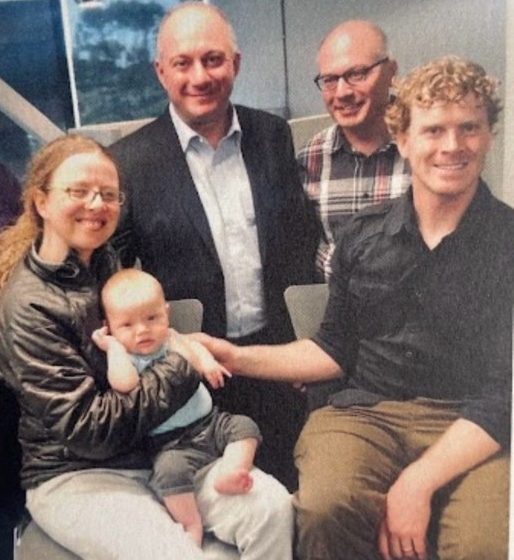
The Philstroms meeting Dr. Brian Kaspar shortly after Edan received Zolgensma in 2019.
Carolyn also quickly became enmeshed in the SMA parent community. Hearing from other SMA parents showed Carolyn that her family’s experience with fast and low-cost access to the necessary treatments was far from the norm for SMA patients.
“It is a little awkward to talk about, but frankly part of my story is that I come from a pretty wealthy and highly educated family and have many friends who are attorneys. Three of them came together and told me that we were going to take my insurance company to court if they did not pay for the treatments we needed. The sad thing that I see on a daily basis is that not many SMA families have resources like that,” Carolyn recounts.
“There are so many health disparities and inequities, even just within Minnesota but dramatically so globally. Our story was the best case scenario. We still to this day see cases where insurers refuse to cover gene therapies, and families have to fight and kids get delayed treatment, which means a loss of motor neurons, which means children might be in wheelchairs for the rest of their lives. It makes me really angry, and I try to use that anger as fuel to advocate for others.”
Because of Zolgensma’s proved efficacy, many insurers in the US cover the gene therapy but others seek ways to avoid having to pay such a steep cost. Carolyn has heard horror stories about this in her SMA parent Facebook group.
“Some private insurers are now just basically saying either we are not covering gene therapies, or we are not covering any medications that were FDA Fast Track approved for the first eighteen years of a patient’s life. So that’s just basically a way of saying we’re not paying for gene therapies,” she explains. “One mom said that she had to quit her job and go on Medicaid to get Zolgensma coverage for her child when her commercial insurer would not cover treatment.”
Carolyn has also developed friendships with SMA families across the world. While there are access challenges in the US, patients trying to get access in low and middle income countries face much steeper challenges.
Between 2020 and 2024, Novartis offered a global managed access program (gMAP) that provided approximately 300 children with Zolgensma for free in 40 different countries. The gMAP provided free access to Zolgensma for eligible patients in countries where it was feasible to deliver the gene therapy but where the therapy did not yet have an access pathway. The program was intended as a temporary bridge to access until ex-US healthcare systems evaluated and determined a reimbursement pathway for the therapy.
Novartis General Manager of Europe, Middle East, and Africa Mike Fraser shared in a 2021 interview at the Fierce Biotech Cell and Gene Therapy Event that at the time, Novartis had negotiated Zolgensma reimbursement to enable access for half of the SMA patient population in Europe and for six countries in the Middle East and Africa. He also noted that healthcare systems “are still not set up to recognize the value of one-time therapies.”
Once a year, Edan returns to the pediatric neurologist for an annual checkup. He continues to not have any SMA symptoms.
“He just passes with flying colors, and he’s running down the hallway, and he’s jumping. He’s this oblivious, totally joyful six-year-old. We tell him that when he was young he got a special test that told us that he needed to get a special medicine. We even show him the video of him getting the gene therapy, and he’s like ‘oh okay.’ It is not impacting him in any way” Carolyn shares.
“We are just lucky and very fortunate and privileged. We live in a country that happened to have the resources to pay for this drug, caught it early on the newborn screening, and treated it early. Now I continue to try to advocate for others so that every child can have the same chance.”





 States of Healthcare
Leave a comment