
Interview with Senator Bill Cassidy, Congressman, Chair of Senate Health, Education, Labor, and Pensions (HELP) Committee, Gastroenterologist and Hepatologist
“The federal government, theoretically at its best, represents the interests of the average citizen… At its best, the federal government makes sure that insurance companies balance their obligation to shareholders with an obligation to the people buying their product.
You don’t want to accuse anybody, but if insurance was trying to give maximal value to shareholders, they would extract as much money from the employees and the employers and the federal government and the state governments paying the bills. You need to make sure that does not happen. I’m a big believer in free markets, but I also know that in this case, they need to be regulated”
– Senator Bill Cassidy, MD
From the Louisiana Hospital to Senate HELP
Senator Bill Cassidy of Louisiana is one of only four current US Senators that are physicians, and one of fifty-four physicians that have ever served in the Senate out of more than two thousand Senators sworn in since America’s founding.
This year he is the Chair of the Senate Health, Education, Labor, and Pensions (HELP) Committee, the Senate committee charged to evaluate evidence, hold hearings, and otherwise investigate everything from public health to student loans, in support of refining related proposed policies. The committee also oversees the Department of Health and Human Services, including the Centers for Disease Control, Food and Drug Administration, and National Institutes of Health.
In the HELP Committee, Cassidy’s medical expertise guides him to ask the right questions.
“Having lived through it, I am better able to analyze and imagine what might be the problem with current policy,” he assesses, citing a recent example where his medical background led him to highlight to colleagues that payment models for antibiotics should incentivize varied use of specific drugs to avoid spreading antibiotic resistance rather than models that incentivize large volume use of a single drug.
Cassidy earned both his bachelor’s and medical degree at Louisiana State University before completing an internal medicine residency and fellowship in hepatology and gastroenterology in Southern California.
Many of Cassidy’s patients in Louisiana (population: 4.6M) were uninsured or underinsured. Starting in 1990, he practiced as a gastroenterologist-hepatologist at LSU Medical School’s Earl K. Long Hospital, a public hospital in Baton Rouge (metro population: 880,000). In 2000, Cassidy co-founded the Greater Baton Rouge Community Clinic, which provided free healthcare for employed but uninsured patients living within 150% of the federal poverty level. Volunteer physicians and dentists treated the community clinic patients in their own practice facilities alongside their privately insured patients.
“I loved what I was doing, treating the uninsured patient, teaching the medical students, doing clinical research, and I was bored out of my mind because I’ve been doing the same thing for twenty-some years. Along came the opportunity to run just when I thought I’d be too old to run, and the rest is history,” Cassidy reflects
In 2006 he won his first election for Louisiana State Senate.
“Partly it was welcome to do something different with my life, but continue the medical ethic of serving other people, and using your training in which to serve other people. There’s a lot of commonalities between politics and medicine. You’re there to serve, and that’s hopefully been my career.”
In 2008 Cassidy was elected to the US House of Representatives. In 2014 he was elected to the Senate, where he is currently completing his second term. Louisiana recently selected a different Republican nominee for the upcoming general Senate election in a contentious primary.
Hepatology in Congress: from Vaccination Guidance to Treatment Payment Models
As the only hepatologist in Congress, Senator Cassidy is uniquely qualified to weigh in on liver-related health policy. It comes up more often than one might think.
The senator has decades of experience treating and promoting vaccination against hepatitis, or inflammation of the liver.
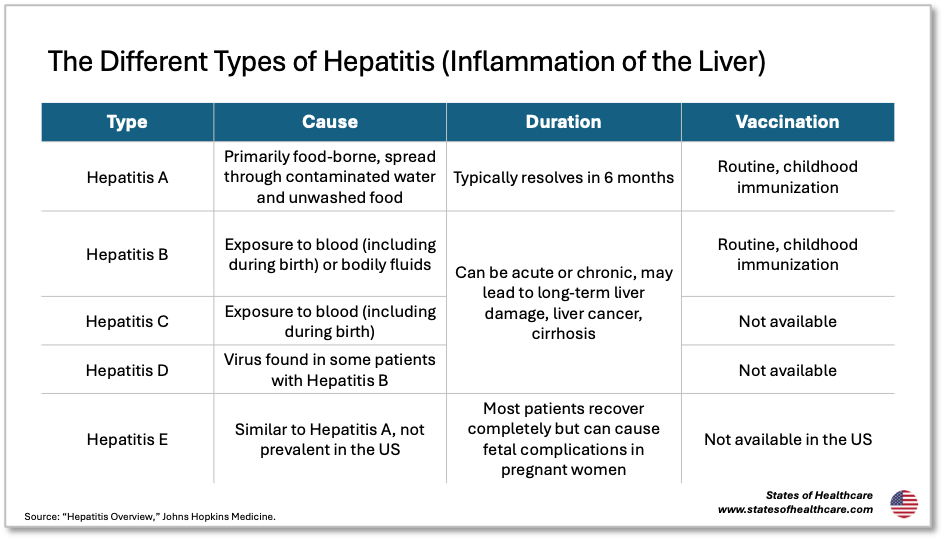
Motivated after treating a teenage patient suffering from hepatitis B-caused liver failure in the ICU who had to be airlifted for an emergency transplant, Cassidy founded the Greater Baton Rouge Hepatitis B Vaccination Program in 1992, which leveraged a public-private partnership to vaccinate 36,000 school children over six years in ten Louisiana parishes (parishes are a Louisiana-specific term similar to county).
In December 2025, the Centers for Disease Control and Prevention (CDC)’s entirely newly appointed Advisory Committee on Immunization Practices (ACIP) voted to adjust the childhood vaccination recommendations to downgrade the hepatitis B vaccine from recommended to “individual-based decision-making.”
Cassidy opposed the action. In December 2025 he tweeted “As a liver doctor who has treated patients with hepatitis B for decades, this change to the vaccine schedule is a mistake… Before the birth dose was recommended, 20,000 newborns a year were infected with hepatitis B. Now, it’s fewer than 20. Ending the recommendation for newborns makes it more likely the number of cases will begin to increase again. This makes America sicker.”
The change to the infant immunization schedule has since been held up in court, leaving the previous recommendation standing currently.
On the other end of the clinical spectrum from vaccination is treatment. Hepatitis C is the most common bloodborne infection in America.
The treatment has a high cost. In 2013, the first curative antiviral, Sovaldi, launched, originally costing $84,000 for a single course. There are now several curative antivirals available, and treatment is closer to $20,000 per treatment course.
The treatment also provides high value. Antivirals can cure hepatitis C infection in more than 95% of patients.
Many payers restricted access to the drugs because of the cost, implementing different requirements including that patients must be sober for a year. Despite this, the Sovaldi launch led to a 25% increase in Medicaid prescription drug spending in 2014. Louisiana determined that treating all eligible patients with hepatitis C covered by Louisiana Medicaid with Sovaldi would cost more than the state’s annual budget for K-12 education. In 2017, only 15% of Americans diagnosed with chronic hepatitis C received treatment.
In 2018, the Department of Health of the State of Louisiana put out a request for information for alternative funding models for hepatitis C therapies. Senator Cassidy, alongside physician-researchers from MIT and Memorial Sloan Kettering, published a JAMA Viewpoint article outlining how an alternative payment model using a “Netflix” subscription model for hepatitis C treatment could increase access.
In July 2019, Louisiana implemented a subscription-based agreement with Asegua Therapeutics (a Gilead subsidiary) for an authorized generic version of hepatitis C drug Epclusa for patients covered by Louisiana Medicaid or in Louisiana prisons.
“If you want to watch every episode of Star Wars on Netflix, it’s a subscription model. You can mainline Star Wars over the weekend, come out bleary-eyed, but you’ve seen every episode, as opposed to going to the movie and paying twenty bucks a pop. In a subscription model you get as much as you want or as little as you want, but you’re paying the same price, and that’s what we did with hepatitis C in Louisiana,” Senator Cassidy explains.
In Louisiana’s 2019 subscription contract, the manufacturer agreed to provide unlimited hepatitis C treatments for no additional cost once Louisiana met an annual spending cap equivalent to what the state had spent on the treatments in 2018. The first year of the Netflix model saw a 535% increase in the use of these therapies for Louisiana Medicaid beneficiaries.
There is currently a House bill, the Cure Hepatitis C Act of 2026, proposing to expand the hepatitis C subscription model nationally. The bill is highly similar to a prior iteration sponsored by Senator Cassidy, the Cure Hepatitis C Act of 2025.
Senator Cassidy has other ideas for expanding a similar model to manage prescription drug costs and access.
“I’ve also wondered, for example, what about a subscription model for some gene therapies in an ultra-rare population to incentivize the development… It is rarely going to happen, but if you want society to bear the risk, then you may have to do it where everybody pays a little bit of money for the subscription to have access to it when you need it, and that would be a true socialization of risk, and theoretically, insurance is about socializing unexpected cost,” he assesses.
On Policy Foundations and Regulation
Throughout his Congressional career, Senator Cassidy has faced two simultaneous mandates: to represent the best interests of Louisiana and America. How do our legislators identify when to legislate policy federally versus leave it to the states?
“You know the old saying that states are the laboratories of democracy. That also recognizes that states are different,” Senator Cassidy notes.
“The rate of poverty in Louisiana is much higher than the rate of poverty in Connecticut. Whenever I see some statistic showing Louisiana doing so poorly relative to Connecticut, I want to say yes, but look at mean income, because there’s a tight statistical correlation between rate of poverty and rate of underlying disease for a variety of reasons, and so Louisiana’s burden, if you will, but our privilege is that we get to address this. We get to come up with the innovative solutions that can hopefully improve the health status of people who are living below a certain income level… The wisdom of our founding fathers was to anticipate that there had to be different solutions for different geographic subdivisions.”
Within this state-forward government approach, Senator Cassidy also identifies a need for the federal government to shape healthcare.
The Senate HELP Committee plays an important role in informing health insurance statutes.
“The federal government, theoretically at its best, represents the interests of the average citizen… At its best, the federal government makes sure that insurance companies balance their obligation to shareholders with an obligation to the people buying their product. You don’t want to accuse anybody, but if insurance was trying to give maximal value to shareholders, they would extract as much money from the employees and the employers and the federal government and the state governments paying the bills. You need to make sure that does not happen. I’m a big believer in free markets, but I also know that in this case, they need to be regulated.”
An Affordability Agenda
A 2023 study found that 30% of American adults with employer sponsored insurance had debt from medical or dental care.
“I read that average credit card debt is $10,000 per family in America. They’re adding to it every month and paying more on the interest because they’re only paying the minimum amount required. That is a ticking time bomb of debt,” Senator Cassidy shares, visibly concerned. In April, Senator Cassidy introduced the Money and Value for Patients (MVP) Act, a proposed series of policies to make healthcare more affordable.
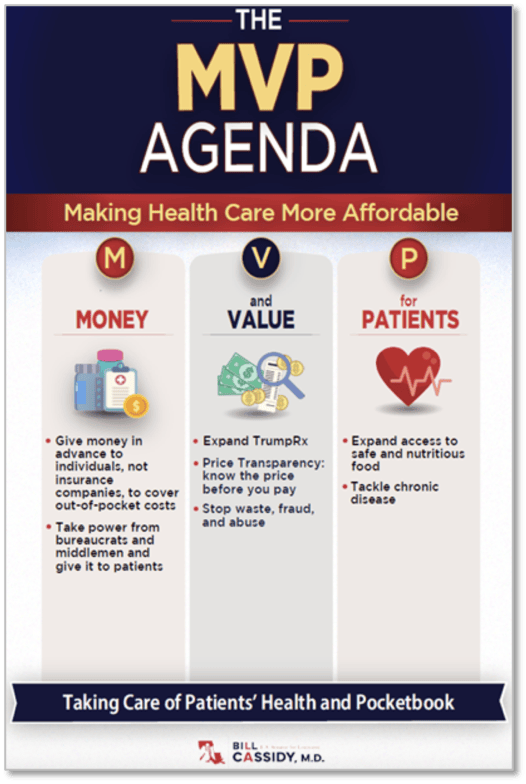
One facet of the MVP agenda is to provide Americans covered by employer sponsored insurance with an advance tax credit to fund a health savings account (HSA). That way, Americans would have access to these funds prior to meeting their annual deductible, when many families might particularly struggle to fund care.
Notably, HSAs are triple tax advantaged. Enrollees get to direct untaxed income directly into the account and then are not taxed on any growth while the funds are in the HSA nor on what is eventually spent out of the HSA.
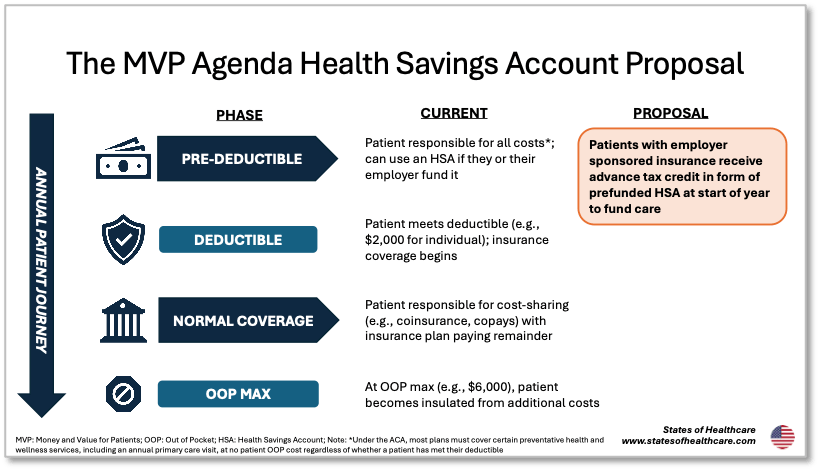
“When you’re below a certain income level, it’s hard to throw off the extra money to go into a health savings account, so that triple tax advantage is going to most benefit the people who have excess income to put into the health savings account,” Senator Cassidy notes.
“What if you evened out the tax benefit, and you prefunded a health savings account for folks receiving employer-sponsored insurance? If you gave the person who’s working hard trying to make it the same tax benefit as somebody who’s wealthier, and you put it in her health savings account up front, she should have money in her pocket to pay her out-of-pocket costs. Even if the policy had a $3,000 deductible, if a family of four received $2,000 in their HSA, they could pay for that out-of-pocket visit to the emergency room or to the urgent care center.”
Lessons Learned from Hurricane Katrina
Senator Cassidy’s voice in the Senate is not only informed from his experience as a physician.
In August 2005 tropical cyclone Hurricane Katrina made landfall in Louisiana with 145 mile-per-hour winds. The category five hurricane was one of the worst natural disasters in American history and decimated regions of Louisiana and Mississippi. After initially missing the city, the storm barraged and then breached the levee system surrounding New Orleans, flooding the area until 80% of the city was underwater.
In the immediate aftermath of the hurricane, Cassidy worked with volunteers to convert an abandoned K-Mart into a temporary hospital for evacuees.
“Katrina was such a disaster in which Louisiana and Mississippi were devastated, and then surrounding states were affected. Iowa was the state that sent a medical response team that helped us initially in our little surge hospital,” Cassidy recalls.
Over twenty-years later, Cassidy takes several lessons from the disaster.
“When the President at first was saying that he’s going to abolish FEMA, I’m thinking you cannot abolish FEMA. If you want to rename it, you can rename it. But we are going to need something… If the resources of the state are so overwhelmed, you need a federal response… I do think that it just makes sense from the federal-state relationship for the federal government to have resources which you can mobilize.”
He cites the deployment of elite FEMA canine search and rescue teams in the wake of catastrophic flooding in Central Texas in 2025 as an example of an imperative recovery resource that most states cannot individually maintain at scale for rare recovery efforts.
“The second thing I learned is that the American people want to help. There were doctors from Chicago, from California, from across the nation, and nurses coming to Louisiana in order to help… Americans wish to help Americans, and that’s really cool. Americans are great people.”
*****
States of Healthcare is now on Spotify! To hear the full interview recording with Senator Cassidy, visit here





Leave a comment