Interview with Payton Herres, Heart Transplant Recipient, Patient Advocate
“I have been with Anthem my entire life. They covered my heart transplant. They covered my everolimus and cyclosporine until last year. Then, they started denying it for me, saying it’s no longer medically necessary…It got to the point where I was running really low on my anti-rejection drug, and that is not good. If I don’t get my meds, my body will attack my heart, and I can lose my organ and die, so I’m like freaking out. I’m like, oh my god, they’re denying me, and I’m running low on my meds. So I took it to Facebook, which was basically my last resort.”
– Payton Herres
The Rejection of an Anti-Rejection Drug
By the time she was eleven, Payton Herres had received more healthcare than most people do in a lifetime. She was born with a rare congenital heart defect, called Ebstein’s anomaly, that causes the tricuspid valve in the heart to not properly close. With this condition, blood shifts between the top and bottom chambers of the heart, making it harder for the heart to pump. This can eventually lead to heart failure and other issues.
Cardiac health challenges plagued her throughout her childhood, until at age eleven she went into congestive heart failure and was placed on the transplant list. After only nine days on the list, she received a heart transplant at Cincinnati Children’s Hospital.
Payton’s transplant fixed her congestive heart failure, but it also introduced its own complications. Her successful transplant started the clock on a lifetime of medical monitoring to ensure her body continually “accepts” her transplanted heart.
Payton recalls that the first year post-transplant was considered the most important. 23% of heart transplant patients in a 2023 study had to be treated for rejection within a year of transplant. Rejection occurs when the organ recipient’s immune system registers the transplanted organ as foreign tissue and attacks it.
“I had to get a lot of biopsies and testing done to make sure I was not rejecting,” Payton recalls.
After she cleared the first year, Payton began taking immunosuppressant everolimus to prevent long-term rejection, called cardiac allograft vasculopathy (CAV). Within the first ten years of transplant, CAV affects about half of patients and is one of the main conditions that can hinder long-term survival after a heart transplant.
“CAV is basically scarring of the coronary artery, and everolimus helps prevent that. I’ve talked to some transplant recipients that had CAV, and they started taking everolimus, and it reversed it and slowed it down,” Payton notes.
Now age 26, Payton has been doing well with her transplant. In addition to everolimus, she also takes cyclosporine, another immunosuppressant. The only downside is that as a side effect from her cyclosporine, Payton has developed chronic kidney disease.
Considering the complexity of her transplant, and how her clinical monitoring has been mostly positive, Payton was surprised to learn in 2025 that her insurer, who she had been with throughout her transplant journey, would no longer cover her anti-rejection medication everolimus.
How to Get Your Heart Transplant Medicine Covered by Going Viral on Facebook
In 2025, Payton’s insurance plan stopped covering everolimus.
Everolimus, brand name Zortress, was first approved by the FDA in 2010. The FDA approved the first generic version of everolimus in 2018. When Payton started everolimus, she took Zortress, but she has been taking a generic version for the past few years.
“I have been with [my insurer] my entire life. They covered my heart transplant. They covered my everolimus and cyclosporine until last year. Then, they started denying it for me, saying it’s no longer medically necessary,” Payton recounts.
Zortress is approved by the FDA specifically for patients who have received a liver or kidney transplant. This means that technically Payton’s use of the drug for over a decade was “off label.” There is a large body of research on everolimus’ use in heart transplant patients, but once a drug becomes generic there is neither market incentive nor realistic funding pathway to operationalize the very expensive randomized clinical trials that would be necessary to gain further disease approvals.
Payton is currently treated at the Cleveland Clinic for her cardiac monitoring. In 2025, the Cleveland Clinic was ranked as the world’s best hospital for cardiology care. Payton wants to remain on everolimus because she has been stable on it for over a decade. Her clinical team comprised of some of the preeminent experts in the world also recommend this.
“My transplant team at Cleveland Clinic sent multiple prior authorizations and had peer-to-peer reviews, and Anthem kept coming back with more denials, saying it’s not FDA approved for the heart, it’s FDA approved for kidney and liver, and therefore it’s not medically necessary,” she explains.
Insurance plans manage access to expensive therapies with several tools, including prior authorizations where clinicians must attest or submit evidence of why a patient fits the criteria to receive a certain therapy.
Peer-to-peer consults are meetings (usually phone calls) between a patient’s clinician and a clinician employed by the health insurance plan where the two parties discuss the insurance’s denial of a prior authorization. Essentially this is where the patient’s clinician argues their case for why the patient should receive the denied therapy, a clinical telephone court room procedural where the defense attorney doubles as the judge.
While the name implies a meeting of peer clinicians, much attention has been raised on the fact that insurance-staffed clinicians often are not true “peers.” In a 2024 American Medical Association survey, only 16% of physicians perceived that health-insurance “peer” clinicians had the appropriate qualifications, with some having trained in an entirely different specialty (such as an OBGYN ruling on neurosurgery care decisions) or not actually being physicians.
“There was a peer-to-peer review, and literally, I’m not kidding, once my doctor got off the call, they denied it,” Payton adds.
When Payton’s insurer stopped covering everolimus, they advised her to take another generic drug instead, sirolimus, first approved by the FDA in 1999. Sirolimus is labeled to prevent organ rejection in patients with a transplanted kidney and to treat lymphangioleiomyomatosis, a rare condition characterized by cysts in the lungs, kidneys, and lymphatic system. Notably, sirolimus does not have an official FDA approval for heart transplant, meaning it also would be used “off label” to treat Payton.
Both sirolimus and everolimus are recommended for use in heart transplant recipients in the International Society for Heart and Lung Transplantation 2022 guidelines. A 2023 study of 17 heart transplant patients who switched between sirolimus and everolimus found that patients tolerated everolimus better than sirolimus. Evidence is nuanced though, suggesting a need for strong clinical decision-making on a patient-by-patient basis.
“I had a friend that’s been on sirolimus, and he had seizures. And I do not want to take a chance and experience more side effects just because the insurance company doesn’t want to pay for everolimus. Also, it doesn’t make sense because I’m sure if I did switch, it would cost my insurance company more money because I’m sure Cleveland Clinic would want to do more blood draws and biopsies and PET scans and make sure everything’s okay. And my doctor doesn’t want me to switch. Like, why switch now? You’re just going to rock the boat,” Payton assesses.
She also was once hospitalized after switching to a different anti-rejection drug, tacrolimus, so she knows that a successful switch is not guaranteed.
Payton kept trying to work through her insurance to get access to everolimus.
“Anthem is frustrating to deal with. I wouldn’t get a clear answer, and I would always have to call them asking, ‘Hey, what’s the status on this?’ And they would be like, ‘Well, we need a prior authorization from your doctor.’ And I’m like, ‘But my doctor just sent one.’ And they are like, ‘Oh yeah, they denied it,’” she recounts.
“It got to the point where I was running really low on my anti-rejection drug, and that is not good. If I don’t get my meds, my body will attack my heart, and I can lose my organ and die, so I’m like freaking out. I’m like, oh my god, they’re denying me, and I’m running low on my meds. So I took it to Facebook, which was basically my last resort.”
Payton’s Facebook post was shared almost 5,000 times. The next day her insurer approved coverage of everolimus for her. However, her out-of-pocket cost increased substantially from what she had previously been paying.
“[Before], my copay was $300 for 30 days or $1,000 for 90 days, but since then it’s gone up so much. Now they want me to pay $500 for 30 days, or $1,500 for 90 days, and that is a lot of money. I don’t know how they think that’s okay. I’m 26. I graduated college a few years ago. I’m still trying to build up my career. I don’t know how anyone… can afford that for life-sustaining medicine. It’s been a nightmare,” Payton summarizes.
Payton and other advocates refer to the phenomenon where a drug is technically covered by insurance but remains inaccessible a “ghost approval.”
“A ghost approval is when technically an insurer approves a medication, but you still can’t get it because it’s either in a high-cost tier or it requires prior authorizations,” Payton elaborates. “Technically it’s there, but it’s also not there. I can’t reliably get it.”
Once Payton’s Facebook post went viral, her story continued to spread. Her story has been covered by CNN, The Independent, and even The Times of India.
Along the way, someone tagged Warris Bukhari, the CEO and Co-Founder of Claimable, an AI product that helps appeal insurance denials. Payton now gets her everolimus outside of her insurance through Mark Cuban Cost Plus Drugs, with the Claimable’s Coverage Fund covering the $100 monthly direct to consumer price.
Payton saw Mark Cuban tweet about her case. Even more surreal, she saw someone in the comments ask Grok, the Twitter AI-bot, if it was true and saw Grok spew out the basic facts of her case.
“I’m really grateful for [Mark Cuban and Claimable] but I shouldn’t have to rely on a billionaire or charities,” Payton notes. She does pay for insurance, after all.
AWP and WAC and NADAC, Oh My!
Let’s dig into the cost of everolimus. Before you read this section, this is your chance to choose between the red pill or blue pill. Once you start to understand prescription drug reimbursement math, it is impossible to go back. Proceed with caution.
Payton takes a generic 0.5mg strength of everolimus twice daily. Payton used to pay $300 monthly for generic everolimus when it was originally covered by her insurer. Now that her insurer has returned coverage, her out-of-pocket cost through insurance would be $500 monthly.
So how much should generic everolimus reasonably cost a patient?
Pharmacy benefit contracts often set generic drug reimbursement through the logic of a drug’s Average Wholesale Price (AWP) minus a certain rate (often 80-90%).
Despite its name, AWP is not necessarily an average nor a wholesale price. For branded originator drugs, AWP is the Wholesale Acquisition Cost (WAC) of a drug marked up by 20%, but generic manufacturers do not have to follow this logic – they can set it as whatever they want. So generic manufacturers set WAC and AWP, and AWP is then often used to set the reimbursement rate for generic drugs in the pharmacy.
An estimated average standard reimbursement rate (employing an AWP minus 80% logic) of generic everolimus is around $250 in 2026.
A publicly available reference price point is the National Average Drug Acquisition Cost (NADAC), which is a CMS-calculated metric of what pharmacies pay on average for a drug. The NADAC for Payton’s monthly dose is $211.
Mark Cuban Cost Plus Drugs sells the equivalent month supply of everolimus directly to patients for $97.
So why would Payton be asked to pay $500 when going through her insurance?
Either the system is broken, or there’s a glitch in the Matrix.
Protecting Christian’s Gift of Life
Payton eventually learned that her heart came from a twenty-four-year-old man from Cincinnati named Christian. Donor hearts must be transplanted within four to six hours of recovery to remain viable, making geographic proximity a key factor in transplant matching. Payton received her transplant at Cincinnati Children’s Hospital, one of the best children’s hospitals in the nation.
After choosing to allow her son’s organs to be donated, Christian’s mother Mary received a letter with an anonymized list of who his organs helped with patient ages and locations but no names. Mary eventually reached out to Payton after a local news segment highlighted her transplant story in conjunction with the heart-focused Cincinnati mini-marathon.
“She looked me up on Facebook and messaged me ‘I think you have my son’s heart,’” Payton recalls.
Payton went through the formal communication pathway at the Organ Procurement Organization to send a letter to her donor’s family, and Mary received it, confirming the connection.
“We have been in distant contact all this time, and we finally met last December because of my insurance struggles,” Payton notes.
Mary was surprised to see the recipient of her son’s heart on the news, this time sharing about her insurance denial for her heart transplant anti-rejection medicine. She once again got in touch with Payton. Mary even offered to pay for Payton’s everolimus, a level of generosity that Payton did not feel she could accept.
“I think she was in total shock when she found out what happened. She probably never thought this would happen to her son’s heart recipient, but we have grown closer. We have met up a few times. I just feel really bad that my insurer is treating her son’s gift like it’s nothing, and they’re okay with letting me die and letting his gift go to waste.”
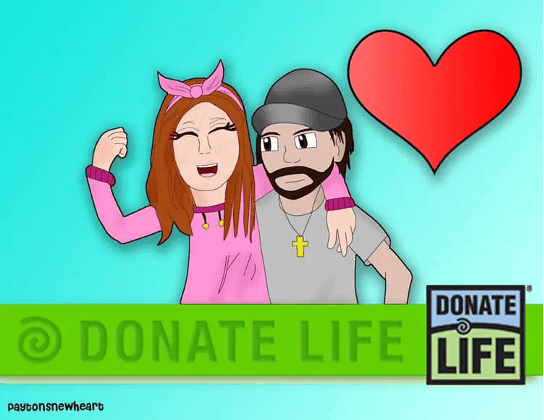
Payton created this image of her with her heart donor, Christian. Source
“I never thought my story would get out there,” she adds, “but if it helps other patients to learn about my story, I’m more than willing to do it.”
*****
States of Healthcare is now on Spotify! To hear the interview with Payton, visit here




Leave a comment